



In medium-voltage (MV) electrical network engineering, selecting the right switching and protection equipment requires understanding the distinct roles of Ring Main Units (RMUs) and larger Primary MV Switchgear assemblies. While both categories operate within medium-voltage ranges (typically 12 kV, 24 kV, and 36 kV) and fulfill safety standards defined by IEC 62271-200, they are engineered for fundamentally different distribution tiers, network topologies, protection complexities, and capital budgets.
What is a Ring Main Unit (RMU)?
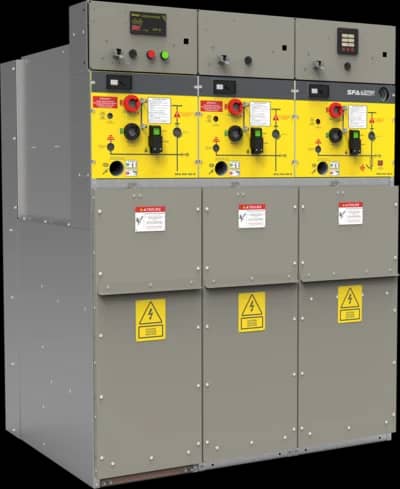
A Ring Main Unit (SF6 Gas-Insulated RMU) is a compact, factory-sealed switchgear assembly specifically engineered for secondary distribution networks arranged in open or closed ring (loop) configurations. In a ring distribution system, electrical power flows through a series of substations; if a cable fault occurs on one section of the ring, the faulted segment can be isolated using the RMU load-break switches without interrupting power supply to the remaining substations.
RMUs are characterized by their standardized, pre-engineered functional combinations housed inside a hermetically sealed, stainless steel gas tank (IP67):
- Ring Switches (C-Functions)Load-break disconnector switches (typically rated 630 A) for incoming and outgoing ring feeder cables.
- Transformer Protection (F-Function or B-Function): Fused load-break switches (F) equipped with current-limiting MV fuses per IEC 62271-105, or compact vacuum circuit breakers (B) with self-powered protection relays.
- Standard Monobloc SchemesCommon configurations include CCC (3 switches), CCF (2 switches + 1 fused branch), and CBF (switch + breaker + fused branch).
What is Primary Medium-Voltage Switchgear?
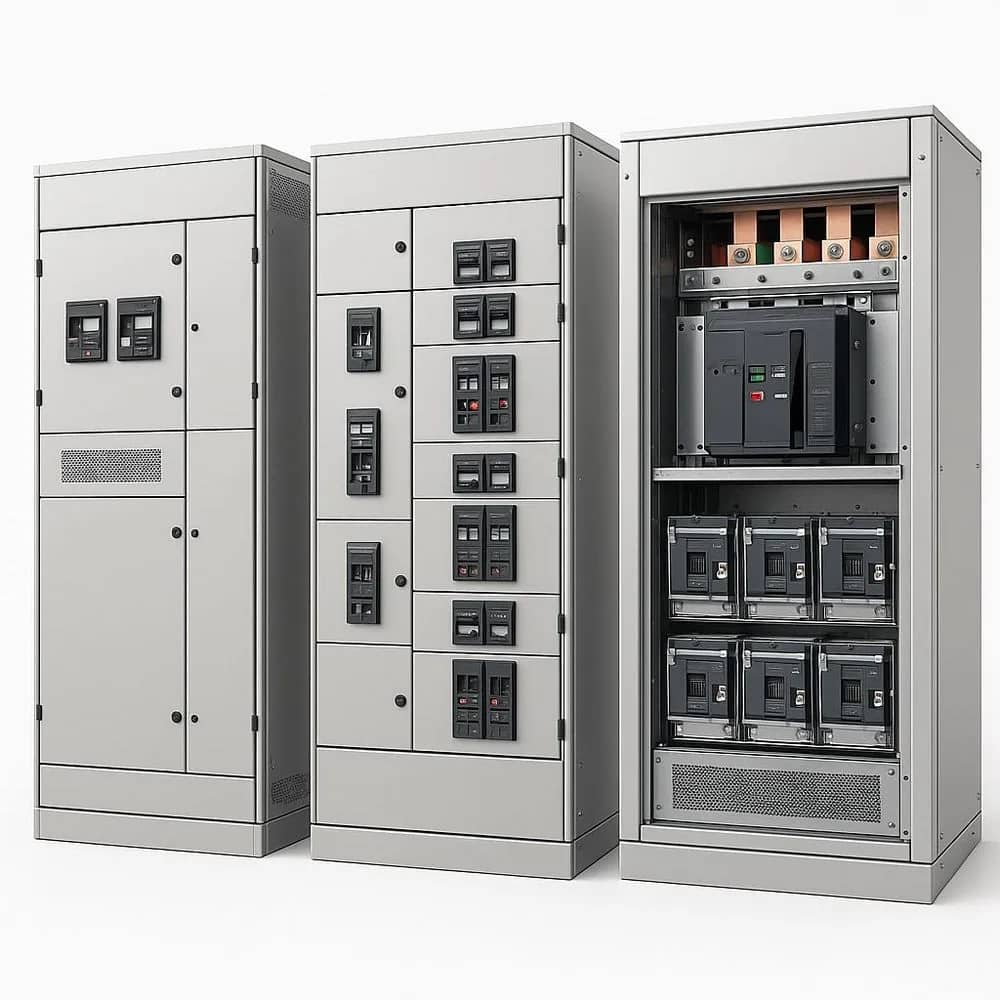
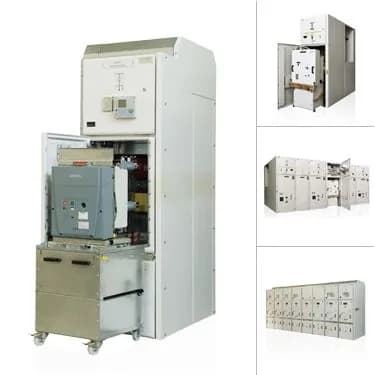
Primary Medium-Voltage Switchgear (Air-Insulated AIS or Metal-Clad Withdrawable Switchgear) consists of individual, modular vertical cubicles connected via a common continuous busbar. It serves as the main intake and primary distribution hub in utility main substations, large industrial manufacturing plants, data centers, and power generation facilities.
Unlike the fixed, standardized layout of an RMU, primary switchgear provides complete modular flexibility with segregated compartments (busbar, breaker, cable, and low-voltage control compartments) and incorporates heavy-duty withdrawable vacuum or SF6 circuit breakers capable of interrupting high short-circuit currents up to 40 kA / 3 s and continuous currents up to 4000 A.
Protection Schemes and Switching Sophistication
The protection capabilities represent a major operational dividing line:
- RMU ProtectionOptimized for distribution transformers up to 1600 kVA (or 2500 kVA). Protection relies either on medium-voltage current-limiting fuses (which offer fast, maintenance-free short-circuit interruption) or low-power CT-driven self-powered overcurrent relays that trip a compact vacuum breaker without requiring an external auxiliary DC battery supply.
- Primary Switchgear ProtectionDesigned for complex, high-power feeder, motor, and generator protection. It integrates high-precision instrument transformers (CT/VT), multifunction numerical microprocessor protection relays (providing differential 87, directional overcurrent 67, distance 21, undervoltage/overvoltage 27/59, and thermal overload 49), auxiliary DC battery backup systems, and comprehensive SCADA communication (IEC 61850).
Substation Footprint, Installation, and Civil Works
Spatial and civil engineering requirements differ dramatically:
- RMUExtremely compact (width often under 1.2 to 1.6 meters for a 3-way or 4-way unit) and lightweight. It easily fits inside prefabricated compact substations (CSS), small outdoor kiosks, basement electrical cupboards, or wind turbine tower bases.
- Primary SwitchgearA multi-cubicle line-up requires a dedicated electrical room with generous front operating aisles (minimum 1.5 to 2.0 meters for breaker racking), rear maintenance clearance, overhead exhaust gas ducts, and deep cable trenches.
Service Continuity and Maintenance Workflow
Under IEC 62271-200, service continuity workflows reflect their target application:
- RMUTypically rated LSC2A. The primary gas tank is sealed-for-life, requiring virtually zero internal maintenance for 30+ years. External mechanisms and cable bushings are inspected periodically from the front.
- Primary Metal-Clad SwitchgearBuilt to Loss of Service Continuity Class LSC2B with metallic partitions (PM). The circuit breaker is mounted on a withdrawable truck that can be racked out for testing or maintenance while the main busbars remain fully energized, ensuring uninterrupted supply to adjacent circuits.
Technical Comparison: RMU vs. Primary MV Switchgear
| Design Criteria | Ring Main Unit (RMU) | Primary MV Switchgear (Metal-Clad / AIS) |
|---|---|---|
| Primary Application Tier | Secondary distribution (ring loops, compact kiosks) | Primary distribution (main substations, heavy industry) |
| Typical Rated Current | 630 A (busbar / switches), 125–200 A (fused) | 630 A to 4000 A continuous rated current |
| Short-Circuit Breaking | 16 kA to 25 kA / 1 s | 25 kA to 40 kA / 1–3 s |
| Switching Devices | Load-break switches, switch-fuse, compact breaker | Withdrawable vacuum or SF6 circuit breakers |
| Enclosure & Insulation | Sealed stainless steel gas tank (SF6 / eco-gas) | Air-insulated (AIS) or gas-insulated (GIS) multi-compartment |
| Service Continuity | LSC2A (typical compact monobloc) | LSC2B with metallic partition class (PM) |
| Protection Capability | MV fuses or self-powered overcurrent relays | Multifunction numerical relays (differential, directional, SCADA) |
| Physical Dimensions | Ultra-compact (fits in compact substations) | Large modular multi-panel line-up requiring dedicated room |
| Capital Expenditure (CAPEX) | Low to moderate; highly cost-effective | Higher investment; justified by power capacity and flexibility |
| Maintenance Requirements | Sealed-for-life primary tank; minimal maintenance | Periodic breaker racking, contact testing, and busbar checks |
Selection Decision Checklist for Project Engineers
Pre-Procurement Decision Framework
Use this checklist to determine whether an RMU or Primary Switchgear is required:
- Network Architecture: Is the installation part of a utility/urban secondary ring distribution loop (RMU) or a primary radial intake substation (Primary Switchgear)?
- Transformer / Load Capacity: For distribution transformers up to 1600–2500 kVA, an RMU with switch-fuse or breaker is optimal. For large power transformers or heavy motors, specify primary switchgear.
- Short-Circuit Fault Level: If site prospective fault levels exceed 25 kA / 1 s, primary switchgear rated at 31.5 kA or 40 kA is mandatory.
- Available Space: If equipment must fit inside a prefabricated compact kiosk or tight basement, select an RMU.
- Protection & SCADA: If the project requires complex differential protection, directional relays, or high-accuracy revenue metering, primary modular switchgear is required.
Need assistance selecting the right medium-voltage distribution architecture? Discover Imperium's MV switchgear and RMU portfolio, explore our compact substation solutions, or consult our technical consulting team for a single-line diagram evaluation via our contact page.
Technical References
- IEC 62271-200High-voltage switchgear and controlgear – Part 200: AC metal-enclosed switchgear and controlgear for rated voltages above 1 kV and up to 52 kV.
- IEC 62271-105High-voltage switchgear and controlgear – Part 105: Alternating current switch-fuse combinations for rated voltages above 1 kV up to and including 52 kV.
- Schneider Electric & ABB Medium-Voltage Distribution System Design Guides.