



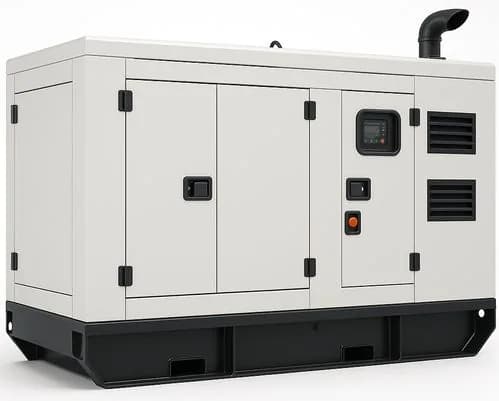
Specifying an industrial diesel generator set is not simply a matter of totaling the nameplate power ratings of facility equipment. An undersized generator will experience severe voltage dips, frequency instability, motor stalling, and engine overheating under transient shock loads. Conversely, an oversized generator will suffer from "wet stacking"—the accumulation of unburnt fuel and carbon residues in the exhaust manifold and cylinders caused by prolonged low-load operation below 30% of rated capacity.
Proper generator sizing requires establishing a comprehensive electrical load profile, distinguishing active power (kW) from apparent power (kVA), calculating motor starting inrush demands, applying ISO 8528 rating definitions, and adjusting for ambient derating factors.
Active Power (kW), Apparent Power (kVA) and Power Factor
Electrical loads consume active power (kW) to perform physical work, while the alternator must supply apparent power (kVA) that encompasses both active and reactive components. In standard 3-phase industrial power generation, generator sets are rated at a lagging power factor (PF) of 0.8:
- Active Power (kW) = Apparent Power (kVA) × Power Factor (0.8)
- Apparent Power (kVA) = Active Power (kW) / Power Factor (0.8)
For example, a generator rated at 500 kVA provides 400 kW of active electrical power at 0.8 PF. If a facility operates at a lower power factor (e.g. 0.7 due to uncompensated induction motors), the alternator will reach its thermal kVA limit before the diesel engine reaches its maximum mechanical kW output.
Establishing the Facility Load Profile
To size the generating set accurately, create an itemized electrical load schedule categorizing facility equipment into three primary groups:
- Resistive / Continuous LoadsLighting, heating elements, resistance furnaces (Unity PF = 1.0, low starting inrush).
- Inductive Motor LoadsPumps, compressors, fans, conveyor belts, MV motors (Lagging PF = 0.8–0.85, high starting inrush).
- Non-Linear Harmonic LoadsVariable Frequency Drives (VFDs), uninterruptible power supplies (UPS), battery chargers, SCR controllers (Distorted current waveforms requiring alternator subtransient reactance X"d considerations).
Running Loads vs. Motor Starting Transients
Electric motors represent the most demanding transient load on a generator. When an induction motor starts, it acts momentarily like a short-circuited transformer, drawing locked-rotor current (LRA) that is 6 to 8 times its normal full-load current (FLA) at a very low power factor (0.3 to 0.4).
The starting method directly determines the transient kVA (SkVA) demanded from the generator:
- Direct-on-Line (DOL)Inrush current is 6.0× to 8.0× FLA. Starting kVA is 100% of locked rotor kVA. Requires significant generator alternator reserve to prevent transient voltage drop exceeding 15%–20%.
- Star-Delta (Wye-Delta)Inrush current is reduced to ~2.5× to 3.0× FLA (starting torque and kVA reduced to 33% of DOL).
- Solid-State Soft StarterCurrent ramp limited to 2.5× to 3.5× FLA with smooth torque transition.
- Variable Frequency Drive (VFD)Inrush current is limited to 1.0× to 1.2× FLA. However, VFDs introduce harmonic distortion (THD) that requires oversized alternator windings or low subtransient reactance.
Generator Rating Standards per ISO 8528-1
Under international standard ISO 8528-1, generator sets are categorized into distinct operational ratings. Sizing must align with the intended application:
- Emergency Standby Power (ESP)Maximum power available for the duration of a utility outage (up to 200 hours/year). The average 24-hour load factor must not exceed 70%. No overload capability is permitted.
- Prime Power (PRP)Continuous supply for an unlimited number of operating hours per year under variable load. The average 24-hour load factor must not exceed 70%, with a 10% overload capability available for 1 hour every 12 hours.
- Continuous Operating Power (COP) / Data Center Continuous (DCC): Constant 100% load for unlimited hours per year, typically used for base-load power stations or critical data centers.
Site Derating: Temperature, Altitude, and Humidity
Standard generator set nameplate ratings are stated under standard reference conditions per ISO 3046 / ISO 8528: ambient temperature of 25°C, altitude of 100 meters above sea level, and relative humidity of 30%. In industrial installations where operating conditions diverge, derating factors must be applied:
- Ambient Temperature DeratingElevated temperatures reduce air density and cooling efficiency. Typically, engine power derates by ~1% for every 5°C above 40°C.
- Altitude DeratingAt high altitudes, thinner air reduces oxygen concentration in the combustion chamber and turbocharger boost efficiency. Sizing typically requires derating by ~3.5% per 300 meters above 1000 meters elevation.
Step-by-Step Generator Sizing Calculation Example
Consider a practical industrial facility scenario:
- Continuous facility running load160 kW of mixed industrial equipment.
- Operating power factorAssumed standard industrial 0.8.
- Base running apparent power160 kW / 0.8 = 200 kVA.
Engineering Clarification on Simplified Sizing
The 200 kVA figure represents ONLY the steady-state running demand. It does not establish the final generator rating.
- If the facility includes a 45 kW motor started Direct-on-Line (DOL) while other loads are operating, starting that motor draws ~270 kVA momentarily.
- To prevent the alternator terminal voltage from dipping more than 15%–20% (which would drop out motor contactors and PLC controllers in your LV distribution panels), the alternator requires substantial transient reserve.
- Assuming site ambient conditions of 42°C ambient temperature and 1200 m elevation (requiring ~8% combined site derate), a robust engineering specification would select a 350 kVA to 400 kVA Prime / Standby diesel generator.
Common Generator Sizing Pitfalls
- Summing only running kW while ignoring motor starting inrush kVA.
- Treating Standby (ESP) and Prime (PRP) ratings as interchangeable.
- Oversizing the generator excessively (causing continuous operation under 30% load, leading to wet stacking, unburnt fuel dilution in lube oil, and carbon buildup).
- Failing to account for harmonic currents (THD) generated by VFDs, UPS systems, and LED drivers.
- Neglecting ambient temperature and altitude deratings in hot or elevated regions.
Information to Prepare Before Requesting a Generator Quotation
Technical RFQ Preparation Checklist
Ensure your procurement request includes these essential technical parameters:
- Total facility steady-state running load (kW and estimated power factor).
- Largest single electric motor rating (kW / HP) and its starting method (DOL, Star-Delta, Soft Starter, VFD).
- Nominal supply voltage (e.g. 400 V, 415 V, 440 V, 6.6 kV, 11 kV), frequency (50 Hz / 60 Hz), and number of phases.
- Application profile: Standby (ESP), Prime Power (PRP), or Continuous Base Load (COP).
- Site ambient conditions: maximum ambient temperature (°C), installation altitude (meters above sea level), and indoor vs. outdoor canopy enclosure.
- Allowable maximum transient voltage dip (typically 15% to 20%) and frequency deviation.
- Planned future facility expansion loads (percentage allowance).
Planning an industrial generator installation or backup power system? Explore Imperium's diesel and gasoline generator sets or consult our technical consulting team to review your single-line diagram and load schedule. Request a customized quotation on our contact page.
Technical References
- ISO 8528-1Reciprocating internal combustion engine driven alternating current generating sets – Part 1: Application, ratings and performance. ISO Standards
- Caterpillar Electric Power Generator Set Sizing & Technical Guides. Caterpillar Power Sizing Resources
- Cummins Power Generation Application ManualLiquid Cooled Generator Sets and Transient Load Performance.